You're good at what you do. Your clients like you. Referrals come in.
And you still wake up wondering why your pipeline feels so inconsistent. Why some months are full and others feel like you're starting from zero.
If that's you, you don't have a marketing problem. You have a word of mouth problem. Specifically, you're asking word of mouth to do a job it was never built for.
Word of Mouth Marketing Is a Relationship, Not a Strategy
Most established service owners don't have a lead generation strategy. They have relationships that have worked so far. Those aren't the same thing.
A strategy is intentional and repeatable. It doesn't depend on whether someone happens to remember your number this month. Relationships are valuable, and I'm not dismissing them. But without a system behind them, they have a ceiling. Most owners hit that ceiling and call it a market problem.
Edward's Story: 15 Relationships in a Market of 1,500
One of my clients, Edward, spent years working toward buying a service company. When the purchase finally closed, he thought the hard part was behind him.
It wasn't. The company had been run almost into bankruptcy. The revenue that looked solid on paper came from large contracts with 60 to 90 day payment cycles and net margins of 6 to 8%. His team was doing the work, fronting the materials, and waiting three months to get paid for jobs that barely covered their cost. As Edward put it: "I don't want to keep being the bank for these projects. And I can't." (If that sounds familiar, it's the classic profitable but no cash trap.)
So he made a clear call. He'd move away from big contracts and go all in on recurring service work: paid in 30 days instead of 90, at around 20% margin instead of 6.
That's where the real problem surfaced. His old model survived on about 10 referral relationships a year. Ten people who called when they had a project. The new model needed 100 service calls a week, which meant steady relationships with hundreds of clients.
When we looked at his market, there were about 1,500 organizations in his territory that fit his ideal client profile. He knew maybe 15 of them. And those 15 called when something broke, not because Edward had a system for staying in front of them.
That's not lead generation. That's waiting.
Why Referrals Work Until They Don't
When your business runs on a handful of big clients, word of mouth feels like a strategy because the math works. One referral covers a month.
The moment your model needs 100 clients instead of 10, that math breaks. You can't referral your way into 1,500 accounts.
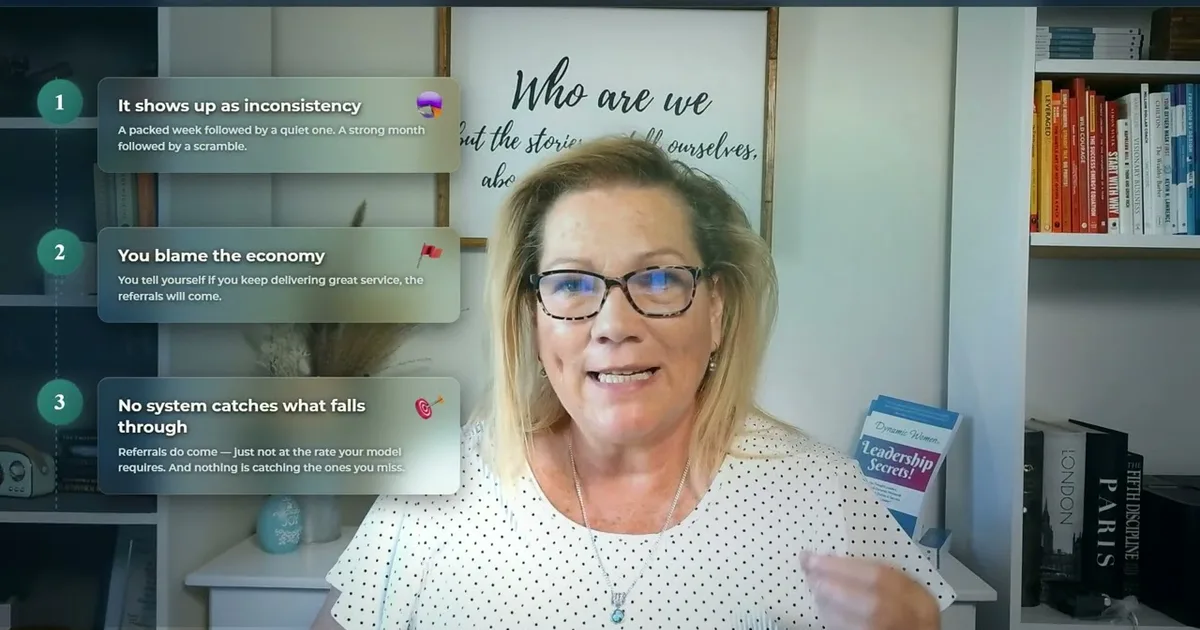
And the gap doesn't announce itself. It shows up as inconsistency. A packed week, then a quiet one. You blame the season or the economy. You tell yourself that if you keep doing great work, the referrals will come. They do come. Just not at the rate your business needs.
Edward's business wasn't struggling because he was bad at what he did. He had excellent service and knew exactly what his clients worried about. But knowing your customer isn't the same as having a system that puts you in front of them.
How to Close Your Lead Gen Gap
1. Map your total market
Before you build anything, know the size of the gap. For Edward, that was 1,500 ideal-fit clients, and he had active relationships with about 1% of them. Not an attitude problem. A math problem.
Then work backward. If each client generates two to three service calls a year, how many active relationships do you need to hit your goal? It's hundreds, not dozens, and now you know the real target.
2. Find your entry point
Edward noticed something most owners in his space missed: larger firms were buying up competitors, raising prices, and losing the personal touch. Their loyal clients were quietly looking for someone who actually picks up the phone. Win just 5% of those 1,500 and that's 75 new clients.
Every market has an entry point like this. A shift, a frustration, a gap the big players are creating. Find yours.
3. Build a touchpoint that helps before it sells
Your clients have deadlines, busy seasons, and requirements they have to meet. Show up before those moments with something useful, like a checklist, a reminder, or a heads-up about a change, and you earn a very different kind of trust than someone who only calls when they want work.
Then make it a documented cadence with an owner and tracked results. Not "I'll reach out when I have time."
Edward said something I hear from almost every owner who's stuck at a revenue ceiling: "I know all of this is in my head. I just don't have it committed to anything official."
Relationships got you here. Systems get you to 100.
Your Challenge This Week
- Map your total available market. Count every organization in your territory that fits your ideal client profile. Write the number down.
- Count your active relationships. Not a name in your phone. People who hear from you more than once a year.
- Calculate the gap. That difference is your ceiling.
Healthy margins make all of this easier, so if yours are thin, start with how to increase profit margins. The lead gen tools inside the Scalable CEO Academy walk you through market mapping, outreach cadence, and tracking. And if you want to build it with support, book a strategy call. We'll map your gap and find your best entry point.